Showing posts with label Unit 7. Show all posts

Wednesday, 18 June 2014

Pitch.


Pitch Presentation.

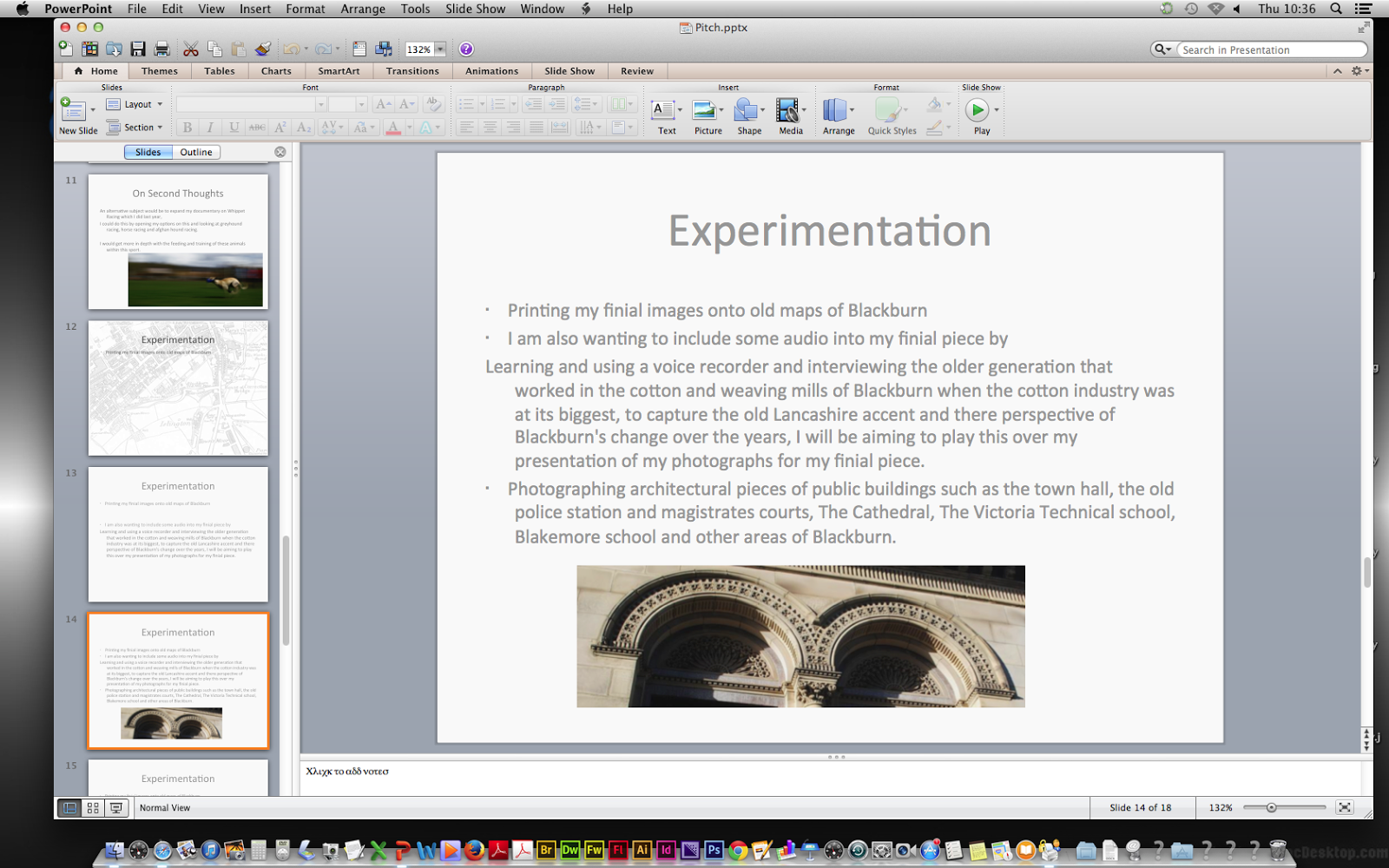
These screen shots below are of my pitch which i presented to the tutors Jamie and Jo, which agreed on the idea of my project. This explains all about my project and what i aim to produce and how to go about it.


Evaluation


Evaluation.

When approaching this project I began with aiming to document the whole of Blackburn and how it has changed over the years, I had planned to show different means of transport which have change dramatically over the years, I was aiming to show this through capturing photographs of the modern transport and comparing the photographs I capture with older photographs of the past means of transport. Also I wanted to look and work closely with the architectural designs within a building this lead me to photograph different buildings such as public houses and shops as these were the social hub of the working community within Blackburn. As I embarked on documenting Blackburn I photographed different variety pubs, architectural features within civil buildings, Street names, shops. After capturing these images I found that this project was too broad to concentrate on the whole perspective as the subject was to large (Blackburn) to full fill. I studied the photographs which I had captured from my shoot and one photograph stood out to me and inspired me to follow a new path of documenting local corner shops as this fitted into my original idea of how Blackburn has changed. With my new idea i decided to document Corner shops within the Blackburn community alongside photographing street names and documenting the history behind each street name.
When I began to document street names I found it very intriguing how each street has its own historical and passed to each individual street name. I also found it interesting that the street names were named after people or things with meanings such as gem stones, trees etc. Within this documentation I focused on the historical facts such as dates of when it was built, the structure of the streets, the meaning of the street name. I also included historical research into these street names. I worked closely when capturing these images with the composition and the negative space within each photograph as I aimed to fill the frame with the street sign to ensure that the viewer’s eye was not distracted. The challenges that I faced when capturing these images of street signs was the location in which the signs were positioned for example on high terraced rows of buildings making the angle challenging to photograph to the full potential, also the signs were located In busy built up area’s which made it challenging to fill the frame with just the sign without having distractions to the viewer’s eyes.
In my assignment i documented corner shops and how they have changed over the years I furthered this by capturing over 70 different shops to help achieve evidence of how corner shops are still thriving in Blackburn despite the threat of the multi-national retailing outlets. I also furthered my documentation of these traditional shops by researching the history, the goods within the shop, the location of these shops, I also worked closely with the architectural detail within each of the shops fronts. When I had planned to capture these images I concentrated on capturing and showing the traditional shop fronts, by capturing these images this is showing how important the shop windows were used to display and advertise goods within the shop. I have aimed to make this the main focal point of my photographs. I also want to show within these images the modernization of these shops over the years. I look closely into the goods that the shops traded in and what they would have traded in originally to compare the old and the new changes within these local corner shops.
When I first started my assignment I looked closely within documentary photographers as I was aiming to document my assignment. The research that I had found and inspired me the most was John Londei, who produced the book ‘shutting up shop’ John Londei worked closely with in traditional corner shops for over fifteen years and captured all his images on 10  x 8 plated camera, where he only included shopkeeper and took great detail into never including the customer. This series of work has helped me further my Idea’s with in corner shops and capturing my images. I have also looked in to other photographers such as Richard Billingham, Martin Parr, Denis Thorpe and Ian Beasley these photographers have also made an impact within my work as I looked closely into Richard Billingham and the structure of his documentary work. I have also included Pablo Picasso the artist within my work as when I looked closely to the images I had produced of each corner shop when you look closely it is made up of all different shapes and lines to produce an image and when I had looked closely with Picasso’s cubism work it was made up of broken down objects and restructured into a painting which you could make out clearly but with the usage of shapes and lines. On furthering my research I wanted to gather information from a generation when corner shops were essential I gained this information by asking people’s opinions on how the corner shops have changed over the years I found the most appropriate way of gathering this vital information would be to but this question out to the people of the face book groups about Blackburn’s past and history. I had a great response from this which has gained me more knowledge and information from people that would have once relied on their local corner shops.
On finalizing my assignment I had many tutorials about how I was going to present my large amount of my suitably for this commercial project. One of the problems that I had come across when deciding how I wanted to present my work was the limited space and the funding’s, I worked around this and decided to produce a 16 Imaged Collage at A1, and alongside publish a photobook with all my images in as when I had looked into separating these image it would of given my final images the potential they hold as each image works alongside each other as a series of images which tells a story without any words. I framed my A1 Image and presented my book within my exhibition space.

Bibliography.


Bibliography 


Bibliography


Beattie, Derek (2007). Blackburn . Carnegie house, Lancaster: Carnegie publishing limited.

Clough, Dean (1998). More Memories of Blackburn, Great Britain : True North Holdings .

Duckworth, Alan (2005). Blackburn, Blackburn: The Francis Frith collection

Londei, John (2007), Shutting up Shop, Stockport: Dewi Lewis .

Moynahan, Brian (1997) The British Century, London, Wiedenfield and Nicholson

Ruhrberg et al, (2005), ART of the 20th Century, Taschen, Cologne


Last accessed 04/06/2014.


Last accessed 10/05/2014.


http://www.johnchillingworth.co.uk/. Last accessed 02/05/2014


Tuesday, 17 June 2014

Exhibition space.


 Exhibition space.

Floating shelve 

My final piece of work is gong to be my book with an A1 collarge framed and hung above this shelf.
This shelf is to use to stand my book stand on with my final piece of work my book 
this glass floating shelf is just a shelf made out of glass and attached to the wall with a metal fitting this looks really professional.


Book Stand.  

Image number two is of my book stand which is constructed by two piece of wood  angled together to make a 90 degree angle with a hinge like mechanism with the use of silver duck tape. I gave this particular book stand five coats of white paint to disguise the silver duck tape which would of distracted the viewers eye from the subject.


Framed out mounted photograph

I printed my image at the size of A1 then i decided to mount my image on white board which is the back of the frame then I hung  it delicately onto the wall within my space to make sure it is level and all wires are hidden.


Printed book.

I prepeared and ordered my book which i had constructed on www.blurb.co.uk
This book is to present my final images in a series, along side my 16 image collage. 


Framed and presented with my book.

This photograph shows my final framed 16 image collage of corner shops with my published book underneath on the floating shelf.


Book on it's stand 

This is my book on it's stand all ready for the end of year show I used sticky pads to secure my book stand to ensure that if people pick my book up it wont fall.


Production of my book.


 Production My Book.

This is my final piece of work which works along side my 16 image collarge at size A0 which will be framed and hung professionally.

This is a screen shot of  the front cover of my book which is all about corner shops.
The image I used on the front of my book i also used on the back put placed the image showing its on a corner terraced on the front of the book.


 This screen shot of the back of the cover on my book i used the front cover but I changed the position making the center of the image the main image.
I do think that this way of presenting my images for my unit 7 for my  final major project is a unique and very professional way of presenting my work and the most appropriate way with the amount of final images i had produced.


This screen shot shows the dust flaps which protects the hard back book, I have wrote a paragraph about my project and added two images to either side so when you look into the book you will see one then when you further through the book up until the back you will find the other with another paragraph with my contact details on.


To design and print this book i used www.blurb.co.uk
this cost £68.00 and gets delivered on 12/06/2014.

Developing My Final Photograph.


Developing My Final Photograph. 


This is the step by step screen shot that i have produced when I have collage my 16 images together producing my final image.

Step one.

I Opened a blank page on photo-shop and then drag down the measuring lines making it 16 equal rectangles at the size of A6 105 X 148 mm making all the 16 images equally spaced out.


Step Two

 I Open an image by clicking file-open  then choosing the appropriate image I then opened this into a new blank page. I then selected the image then I re-sized this  images to 105 x 148 mm i furthered this by clicking on image - image size which brings up the box which you can see in the screen shot below were you type the sizing in then click ok. Then you press command A then copy and paste the image on  the girded page which I had already constructed.


Step Three

I then pasted the images individually into this grid. were I then selected and lined up into the top left hand corner of each A6 blank area. Then clicking on transform scale then using the shift button whilst dragging the image to the correct size I in the correct rectangle. I  continued this process until I changed the size of the DPI  to 600 so that the print quality was good.


Experimenting With Final Photograph


Experimenting with final photograph

This is my idea for my final image along side a photo book i am aiming to produce. My final Photograph is made up of range of 16 of my final images of corner shops which I have sized at A6 105" x 148"mm. These images I have made all the same size to able me to collage them together precisely to make up a A0, 841x1189 mm final image. When I  produce this final piece of work which will look like the one I have shown below, I will be deciding on whether a themed outcome for my photographs, for example all shutters down or all shutters open will make it look more sustained. I have used photo-shop when collageing these images together to make sure I place them accurately. The challenges I sustained when collaborating these photographs together was the decision on if to use a themed image all the way through the collarge or if to have a variety of different kinds of shop fronts, I worked through this by tutorials and looking at which way would be the most appropriate way of including all these image.
I am framing this A0 image and hanging it displayed along side the book I am producing.


When re-collarging my images together, I need to ensure there is no white lines in between images I will be doing this by making sure I place images close enough together so they touch on all four sides.


Photo labs prices/printing


Research on Photo labs prices/printing.

My idea is to print my final image at the size of A0. This image with be a collage of my corner shops as i have 75 final images but don't have the space to display all of these photographs, and also the price of printing is quite a high factor to take in to consideration. I have combined my 16 images to produce my final piece of work along side a book which I am producing so I can use the whole of these series of images as they work along side each other. I have done some research on what I want and I am aiming to also look into having a very high standard of photo quality, I am also going to look into having my final image printed on a textured matt paper to bring the image alive. I spoke to martyn before I decided to collaborate these 16 images together were we discussed printing and suggested Paul graham's 


Printing Labs/Prices.

Metro Print 
Metro-printing.co.uk
Ao
Matt
£63.00


DSCL
DScolourlabs.co.uk
A0 
satin 
£49.99


The print space
theprintspace.co.uk
A0 
C-type Matt
£54.56


Blackburn college reprographics
A0
Matt
£11


Professional photo prints
professionalphotoprints.co.uk
A0 
Matt
Rectangle large format print
£32.00


Paul Grahams 
A0 
Textured matt
£50


Developing My Idea's.


Developing My Idea's

These are my Idea's for my starting point for my final major project. These are idea's such as the things i'm aiming to photograph and also the structure of the images and also the way in which I am aiming to capture the images. I made this mind map to help me concentrate and keep Idea's forming for my final major project. 


I formed this mind map to help me plan out the area's I am going to photograph around the Blackburn area, I will be adding more area's to this mind map as i go along to show the area's I visited to captured  photographs of street names and local Corner shops.


The mind map below shows all the street names i will be aiming to capture to produce my series of street name photographs. I have used a large range of street names which are in all different parts of Blackburn such as areas like, the town center, roe lee, revidge and many more.

These on the below mind map are the goods that a traditional corner shop would of traded to the locals of the area. These have changed over the years, but some have stayed the same.
This list helps me gather information about these goods so i can compared the change in the goods which, are sold now to the ones that was sold as some of these are still sold in our local corner shops today.


Monday, 16 June 2014

Experimenting With Angles

Experimenting with angles ''Bulls Head''


1)


2)

Evaluation.

When planning to go and photograph this pun ''the bulls head'' i had planned to concentrate on the angles and the lines which make up the photograph in which i did and you can see in these photographs.
As you can see i decided to capture this photograph central with the main door. There are many shapes within this one building some being triangle, rectangle circle windows and many others. In photograph number two i think it is alot better composition and i thought it out alot more thoroughly this is shown from the angle which is just of center to the bridge i did this to make sure i captured and filled the frame fully and to the best of my ability.
This image is made up of many shapes/lines which are shown through the yellow lines on the road shapes within the iron work on the railway bridge and also within the building itself the use of black and white within photograph number two shows greater characteristics and somehow makes it have an age about this image in my opinion this bottom photograph works better than my original image. 


Sunday, 15 June 2014

John Londei Research.


John Londei 

''His Words''

This project shot over a fifteen year period as my photographic tribute to an era that is fast disappearing all the photographs were captured on a 10 x 8 plate camera.
It began in the 1970's when i came across an old chemist shop near to my first studio in leather lane, there were something about the shop that fascinated me. It was more than a shop it was a place were people went for advice for there aliments were the owner had time for the customers as a photographer i just had to capture it on film i knew its days were numbered in all there is 60 shops each one is unique and each has its own field speculation. The range is from diverse from flowers to condoms from ballet shoes and to umbrella's aswell as london shops the scence covers many parts of the country from the isle of harris to the isle of wite customers were never included. just as important as the shopkeepers.
they were integrate to the photographs and as such i approached the project as a portrait to these people running the shop meant so much more than a business some how it felt as if they turned the premisies into living in titles and them self
 were cherished and long serving memebers of the community. And how proud they were to still be serving it. I was constantly surprised at the coporation they gave me dispite the time taken with setting up, composing and lighting. I cant tell you how many times i have had to wait patiently for customers to leave or the number of blown fuses due to antiquate  electrical system.
I think the timing was spot on visually the shops were at there peak they had a faded beauty a pertain the only the passing years could bestow and like there shops the owners were mostly elderly way past retirement i admired there stubborn refusal to submit to the relentless march of time. In the end for so many of the traditional small shopkeepers represented had, it would be ill health that brought down the shutters on there cherished shops forever.


Corner Shop 1982, 78 Chapel Green Road, Hindley Wigan Lancashire.
''This Shop Doesn't Need A Need.''


Chemist 1973, Morrisons Chemist 101 Leather Lane London ECI
''We  Took A Load Off The Doctor''


Barber, 1981 High Street Prestwood Great Missenden Buckinghamshire
''I Guess I'm Part Of The Scenery'' 

FishMonger, 1984, Geo Tallet & Son 22 Broadway market, Hackney London E2 
''Soon as they throw us out, we're finished''


Butcher, 1978 Fred Butler & Sons 2 Fagley Terraced, Bradford Yorkshire.
''Now and then it feels as though its all been a bloody waste of time.''   

Green Grocer 1983, C.Powell 15 Brockley Rise Forest Hill London SE 23 
'' Keeping Us honest and growing up strong.''

Jewish Deli, 1983, Rog's 137 Cannon Street London E1 
''I've done a double life sentence.'' 


John Londei Evaluation.

When you look closely in to Londei's work, you can automatically see he captured all the images on film, ''10x8'' plated camera which has gave each individual photograph a vignetted effect around the corners some being more defined than others.
John Londei when photographing must of built up a relationship with all these shop owners which has helped contribute to these photographs composition. I like how he has not just captured the outsides of each shops, but ventured into the shops and captured them working and it all shows how traditional shops would of looked and functioned. 
You can see that each of these photographs which John Londei has captured has great composition and can speak a million words, which help to bring photographs like these come alive. He hasn't just focused on the type of local shop he has took all different types of local shops into consideration such as barbers, butchers, fishmongers, and many more. I have chose to use these 7 photographs which i photo copied out of the book shutters down as these are the main ones that stood out from the rest and have a very traditional look to them.
This is a great series of photographs that John Londei captured over the fifteen year period. and still play a major part in the way today's corner shops are run in Blackburn.

Pablo Picasso's Researc


Pablo Picasso Research. 

I have researched and looked closely into Pablo Picasso's cubism paintings
as the cubist paintings are made up of broken objects and shapes which resemble in
an abstract form highlighting the defined shapes, Picasso was also known for his 
collage-like effects which made one painting. I am working very closely with angles within this project which is why I have been inspired and looked closely into Picasso's cubism paintings as you can see with the work there are lines and angles in which i aim to look closely into within this project. 

Pablo Picasso's Cubism 

'Still Life with mandolin and Guitar', 1924 (oil on canvas)
(1881-1973)
Weeping Woman', 1937 (oil on canvas)


This is another example of a cubism painting, this isn't Pablo Picasso's work.


I have researched and looked closely in Picasso's cubism paintings as the cubist paintings are made up of broken objects/shapes resembling in an abstracted form, highlighting the defined shapes, Picasso was also known for his collage-like effects which made one painting. I am working very closely with angles within this project which is why I have been inspired and looked closely into Picasso's art forms. As you can see work there made up of lines and angles in which I aim to work closely along side within this project.

All these three images i have chose are made up if angles/shapes/line. 
Which I am working with when capturing my corner shops as how all the different shapes on the buildings make up my one photograph.

Saturday, 24 May 2014

Discussion on traditional corner shops.


Screen Shot's From Discussions.

Below there is 4 screen shots were I had joined groups such as Blackburn past and history of Blackburn on a Facebook page which is where people can discuss all about the history of Blackburn. I put on a question which was "I'm just wondering if anyone can help me, i'm studying photography and i'm doing my final major assignment at Blackburn college, i'm documenting corner shops and how they are thriving in Blackburn and id like to know other people's opinions on how they have changed over the years? this would be a great help thank you", With this i got a great response from many people of the generation were they had lived through have a corner shop etc these are the screen shots of which i have written out each response underneath.

History of Blackburn Lancashire.

This screen shot is of the page History of Blackburn where my responses wasn't as good as the other pages i had posted this on as there was only one useful comment placed on this i have used this as evidence of what a corner shop was like in the past.


Blackburn Past

The screen shots below show a post which I posted on the Facebook page Blackburn Past on facebook which is another history page within Facebook, i got a great response from this group as you can see in the screen shots below i have also copied these out too as it is all evidence of what a traditional corner shop looked like.


What people's opinions are on traditional corner shops.


Judith Addison.

" I've always lived in Oswaldtwistle. There were alot of corner shops when i was a child in the 1950's, mostly grocers, There main advantage was that you ordered your bread there everyday from Monday to Saturday. It would usually be a child of the family to went to the loaves up and ordered for the next day. Corner shops were also known for the "Penny box" from which children bought sweets for example penny arrow bars, with there spending money. Their were alot of other kinds of shops on the street corners in particular chip shops. Most shopping was done locally on a daily basis at corner shops or shops on the main road of your local town, especially the co-op. On a Saturday afternoon the shops in the small towns were closed you went down to Accrington market on on the bus. Milk was delivered daily by the milkman who might of been a local farmer or it might have been from a local dairy like white-well dairies most household didn't have a fridge most people had a daily paper delivered from the local newsagents now most of the corner shops are converted into houses".   


Lee A Gosling.

My great aunt had a corner shop in Blackburn, she invented penny lolly's i think, 
I am pretty sure she was still receiving royalties up to her death years ago because Walls bought the idea. 


Carol Osman

My Nan had a grocery shop on the corner of wimberly street, there seemed to be a shop on most corners then, she sold all of the usual things, there was a tin with a glass top that had broken biscuit's in and we was allowed to have 2 bits each "wow we thought we was so lucky" and if i helped her serve a customer then i was allowed a whole one. It is a shame that all the houses and the shops have all gone and new houses built in their place. A lot of changes have been made to Blackburn and some not for the better, so that is what i think.


Anne Holding.

Our local co-op had a long wooden counter. Butter was cut and weighed on the scales, Bacon was sliced while you was there. Biscuits were in a wooden case with a glass front and you could choose a few of each as you wanted, dog biscuits were in a big sack and was picked out with a big scoop and weighed for you "NO SELF SERVICE" you made your shopping list before you went and handed to the shop keeper and she would reach down what you wanted we also had a green grocer with a horse called (dobbin) and cart that came round door to door he had fish on the back which he headed and tailed for you and threw the fish heads to the local cats who waited at various points down the road. It wad a treat to give dobbin a carrot. Cake shops had the cakes on glass cake stands in the window.

Francis Buckle.

The corner shops as my generation new 72 years are in a different time warp now...maybe chip shops, hairdressers (unisex) even cafe's and a whole range of different variety of things now to try and tempt us all in. Mostly grocers and green grocers, wool shop,iron monger, mostly the everyday essentials which was needed and could afford and if you had little money the grocer would put you items on the tick ie: you payed at the end of the week (payday) we had no credit cards in those day nor cheque books... all we had was cash that's why you kept the same grocer... i have owned hairdressers in the past and that is the only way some people could manage to get their hair done these days Tesco's etc have in store salons these days, i now live in Leyland (but most of my life has been in Blackburn) and we had a lot of of corner shops...butchers,barbers,mobile phone specialist and we have now got a corner shop that's an old fashioned ale house, we even have an old fashioned toffee shop but the big boys are the grocers. 


This is a photograph which Francis Buckle emailed me and sent information about.

" These where the posh shops in Blackburn her parents would use these on a Saturday maybe if they had a bit of money.


Jayne Vernon.

It used to be safe to send a young child to the corner shops and they new who you were so you couldn't get away with anything in the days of people having newspapers delivered to them it kept the shops in touch with the local community. Now there aren't so many and it ain't so safe and they seem less personal. 

Angela Mason.

Wish life could go back to those lovely times, I'm only 51 so although i remember the corner shops they were already changing as i grew up. However things are different now. No personal services, no one has a time for a chat, supermarkets are too busy, hate the even more shopping trolleys that go around the supermarkets, "how unsociable is that when people won't even go to the supermarkets but sends a worker around to shop for them!!! We have a local corner shop up until last year when it was sold to a new owner he used to drop all the old folks heavy items off or if they couldn't get there due to ill health he would drop there shopping off until they were better.


An out line of what a traditional corner shop was and the goods it supplied based on the opinions on the Facebook groups.

This is my overall evaluation on traditional corner shops, I have gathered this information to give me a bigger insight of what a local traditional corner shop would of operated like.
All these opinions are off local Blackburn people and the surrounding area. These opinions are of a generation that grew up through the times when corner shops were thriving, traditional style shops. There opinions are of how the shop operated I.E, the way the shop keeper would serve you. This entailed you giving the keeper your shopping list and he would gather together the goods you needed, Also most goods were behind the counter and was supplied to you fresh unlike today's modern packaged goods.
The way the shop traditionally looked compared with today eg, traditional big wooden windows which allowed the goods to be displayed. They also told there opinions of how the traditional corner shop was the main hub of the community eg, the shop was not just a business it was your neighbor and everybody new each other. Other opinions are of how you can have goods on credit "TICK" which they would collect there goods daily but pay on their pay day of that week. This is a proven traditional way of surviving for the traditional families of that era compared to the modern day as credit has changed as now we have credit cards, and other methods of credit. Another opinion is the way the traditional shop sold their goods they did this by selling there goods in small quantities eg, selling single biscuits to the local children compared to the modern day were they would only be sold in a packet with a minimum quantities in the packet and also meats such as bacon was freshly sliced and other foods were wrapped in paper.